For Oura · Whoop · Garmin · Apple Watch users
Did the sauna
actually move
your numbers?
It's a fair question to ask. You sit at 180°F a few times a week, your HRV drifts up and down, and nothing tells you which part of that was the sauna and which was a late dinner or a short night.
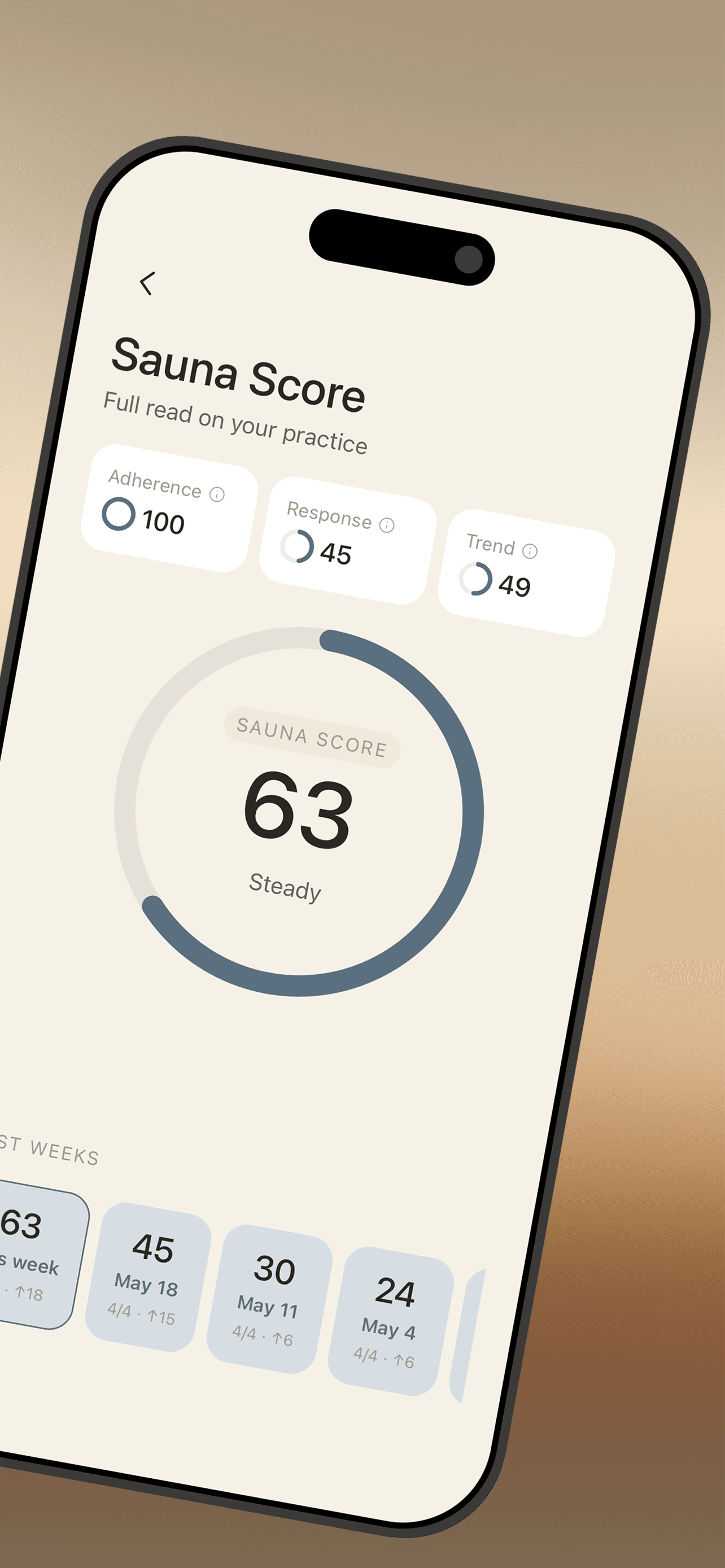
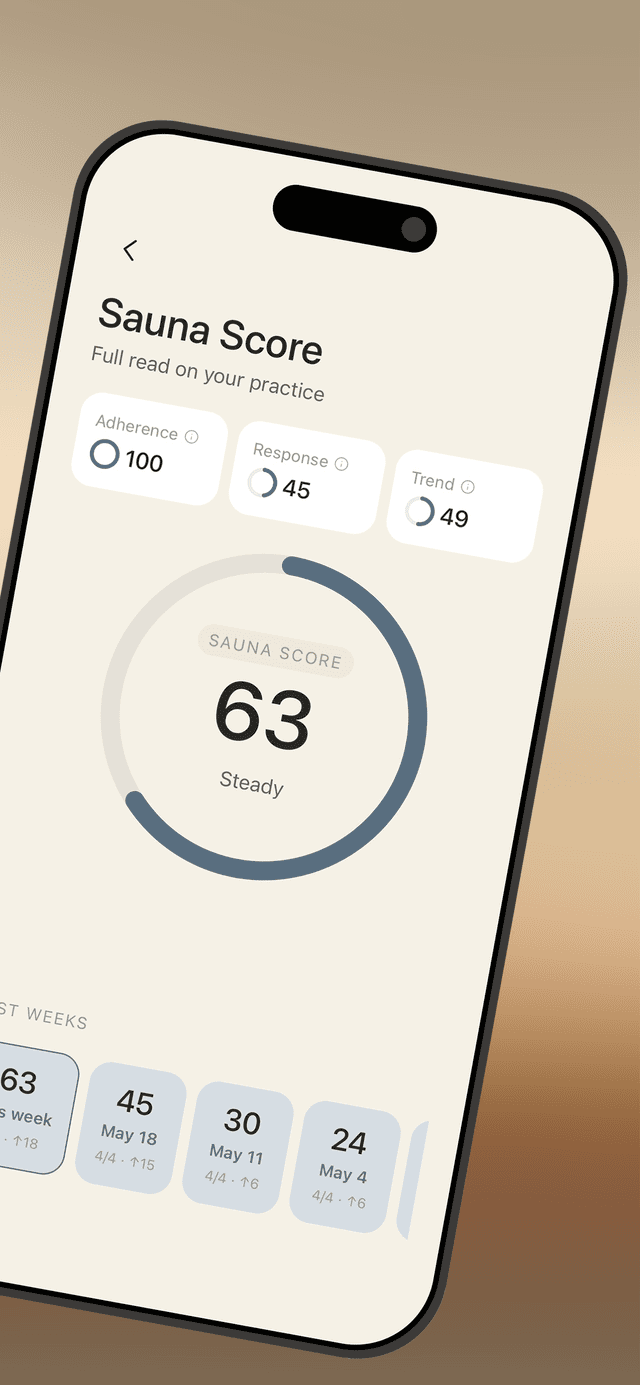
That's the question Sauna Score is built to answer. It lines up your HRV, resting heart rate, and sleep on the weeks you hit your protocol against the weeks you didn't, which is the same comparison the Laukkanen study ran, except both groups are you.
The attribution problem
Tracking apps log what you did. Sauna Score tells you what it did to you.
Start with what your wearable already gives you, which is a lot of data and no real conclusion. It logs HRV, sleep, and resting heart rate every day. What it doesn't do is tell you whether the sauna is the reason any of it moved, and that's genuinely hard, because those numbers also shift with work stress, travel, alcohol, a head cold, and how you slept last night.
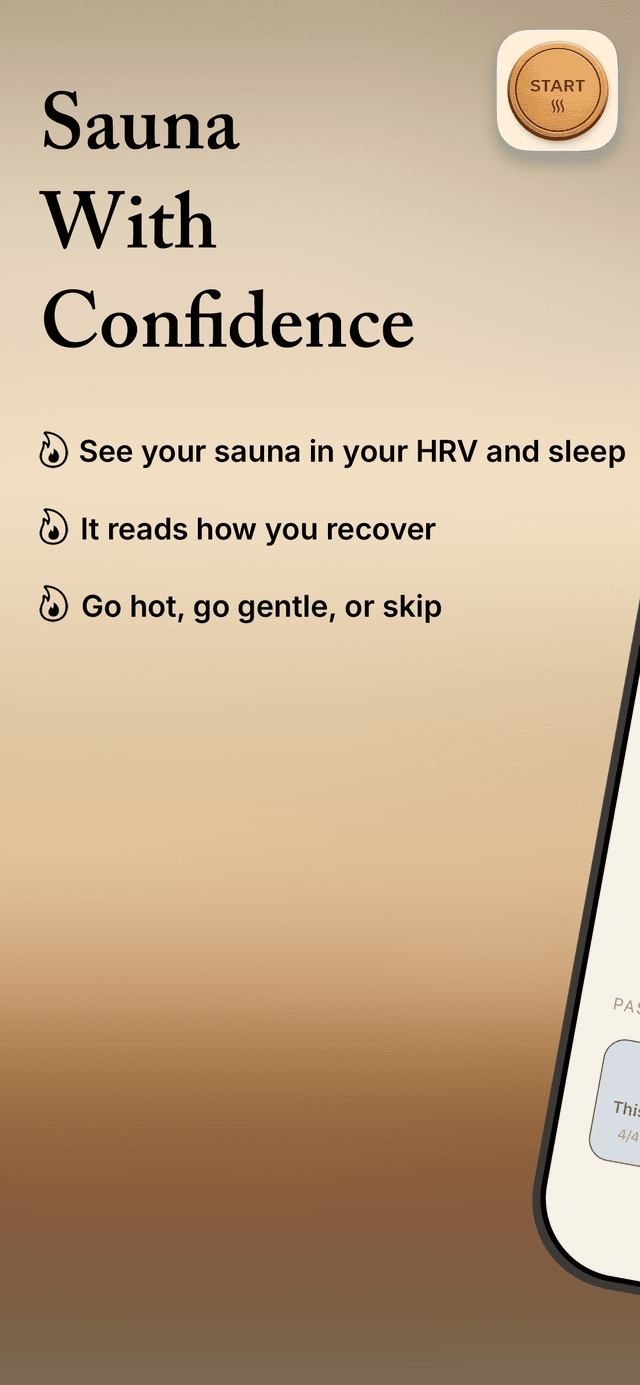
So here's the approach Sauna Score takes. It compares your weeks at the protocol cadence against your weeks below it, tracks your HRV over the last eight weeks, shows where you land against age-and-sex norms, and puts a confidence band on every number. And when the data is too thin to support a claim, it tells you that, rather than handing you a trend that isn't really there.
Protocols, by name
Pick the study you trust. Run the cadence it ran.
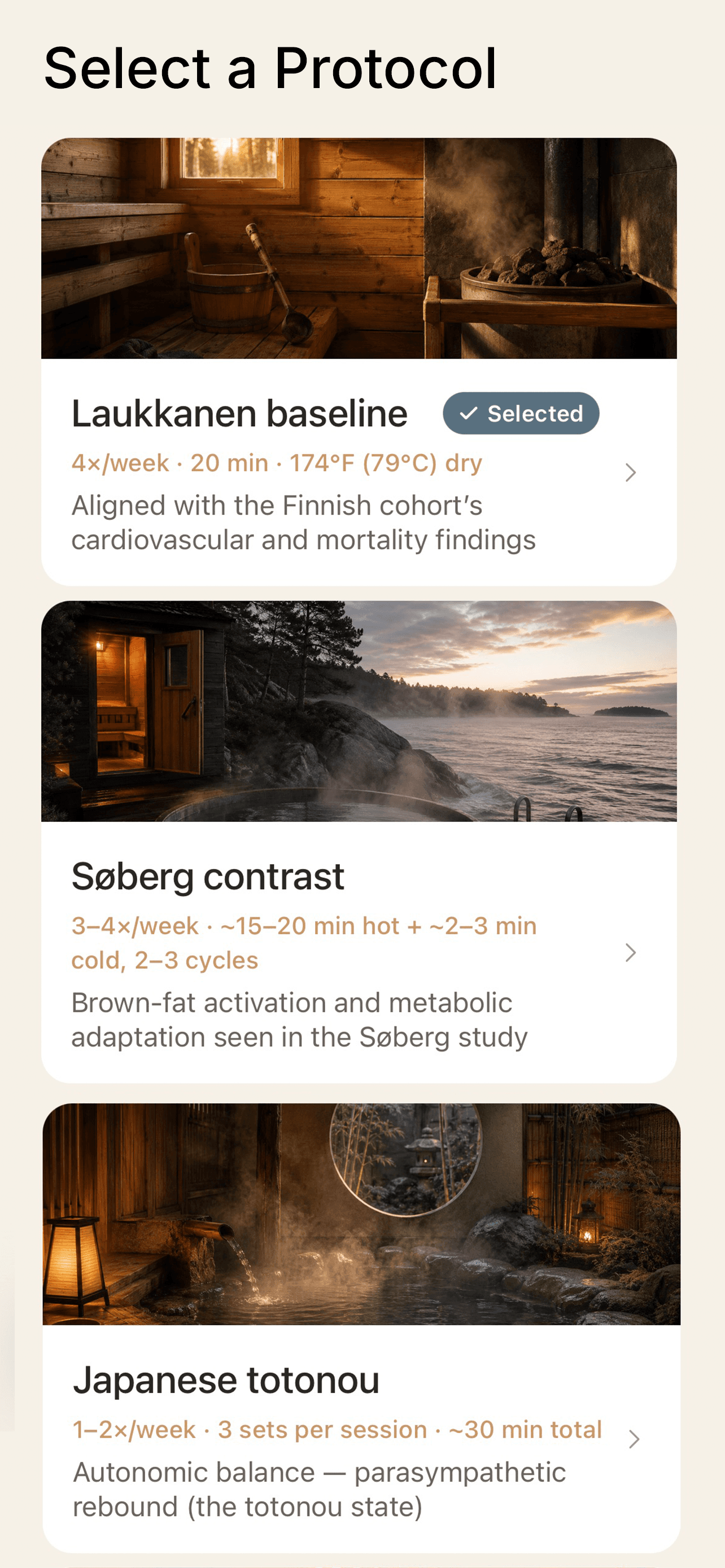
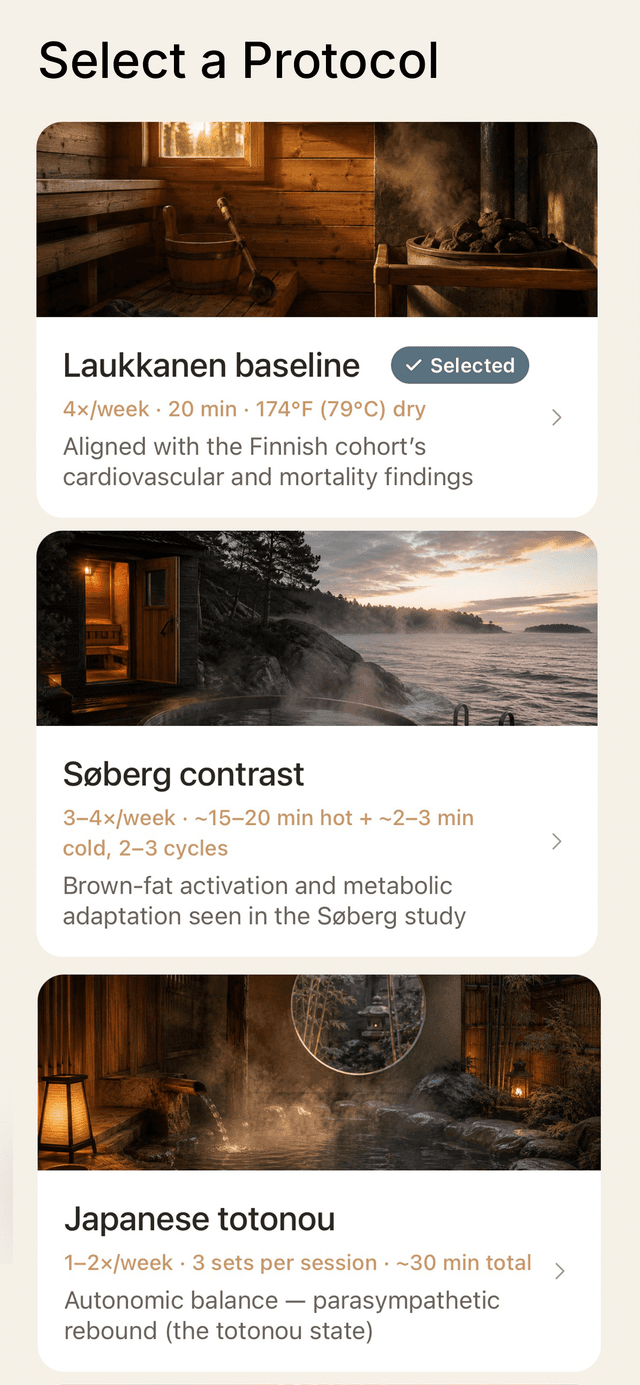
One thing worth knowing about the research: the benefit numbers are tied to a specific cadence at a specific dose (how often and how long), not to sauna use in general. So Sauna Score asks you to pick one of those cadences up front, and then reads your response the way the study that produced the number actually measured it.
Laukkanen
4–7×/week · 20 min · 174°F dry≈50% lower cardiovascular mortality, ≈40% lower all-cause mortality at the high end of the cadence. Laukkanen JK et al., 2015, JAMA Internal Medicine. Observational, n = 2,300, 20-year follow-up. The longevity default.
Søberg contrast
57 min hot + 11 min cold / weekHot sauna + cold plunge, end on cold. Brown fat activation, metabolic and recovery benefits. Søberg et al., 2021, Cell Reports Medicine.
Japanese tōtōnoū
3-set ritualThree rounds of heat → cold → rest, ending in the parasympathetic rebound the Japanese call tōtōnoū. Lighter heat dose, autonomic focus.
Beginner ramp
3 weeks to LaukkanenBuild heat tolerance and habit gradually. Bridges into the longevity protocol without the first-week dropout.
Weeks, not sessions
Adherence-stratified, the way the studies are designed.
Once a week, you see your HRV, resting heart rate, and sleep on the weeks you hit the protocol target, side by side with the weeks you didn't. This is the same comparison the Laukkanen study made, four-times-a-week men against once-a-week men, just run on a group of one: you. What matters is the gap between those two sets of weeks, not whatever your HRV happened to do on a single Tuesday.
Every number wears a confidence band: “signal probable,” “below threshold,” or “needs more data.”
The goal is a trend you can actually trust, with its uncertainty shown, rather than a daily score to chase.
Honest about the evidence
The science we cite — and the science we don't.
The famous Finnish numbers, the ~50% lower cardiovascular mortality at 4–7 sessions a week, come from Laukkanen et al., 2015, in JAMA Internal Medicine: 2,300 men, 20 years of follow-up. That's a strong, consistent correlation, and it's worth taking seriously. It's also not a randomized trial, which matters, because it means the studies can show sauna use and longer life travel together but can't prove one causes the other.
The randomized trials that have run since are more cautious. An 8-week post-exercise sauna study found no extra HRV benefit over exercise alone; a 2023 trial found no meaningful vascular difference versus control after eight weeks. So the fair summary is this: the population signal is real, the right dose for any one person isn't settled, and your own response is genuinely your own.
That gap is the thing Sauna Score is built around rather than built to hide. Every claim wears a confidence band, and the numbers it shows you are yours, read from your own data over time, with an explicit range of what that data can and can't support.
Daily heat readiness
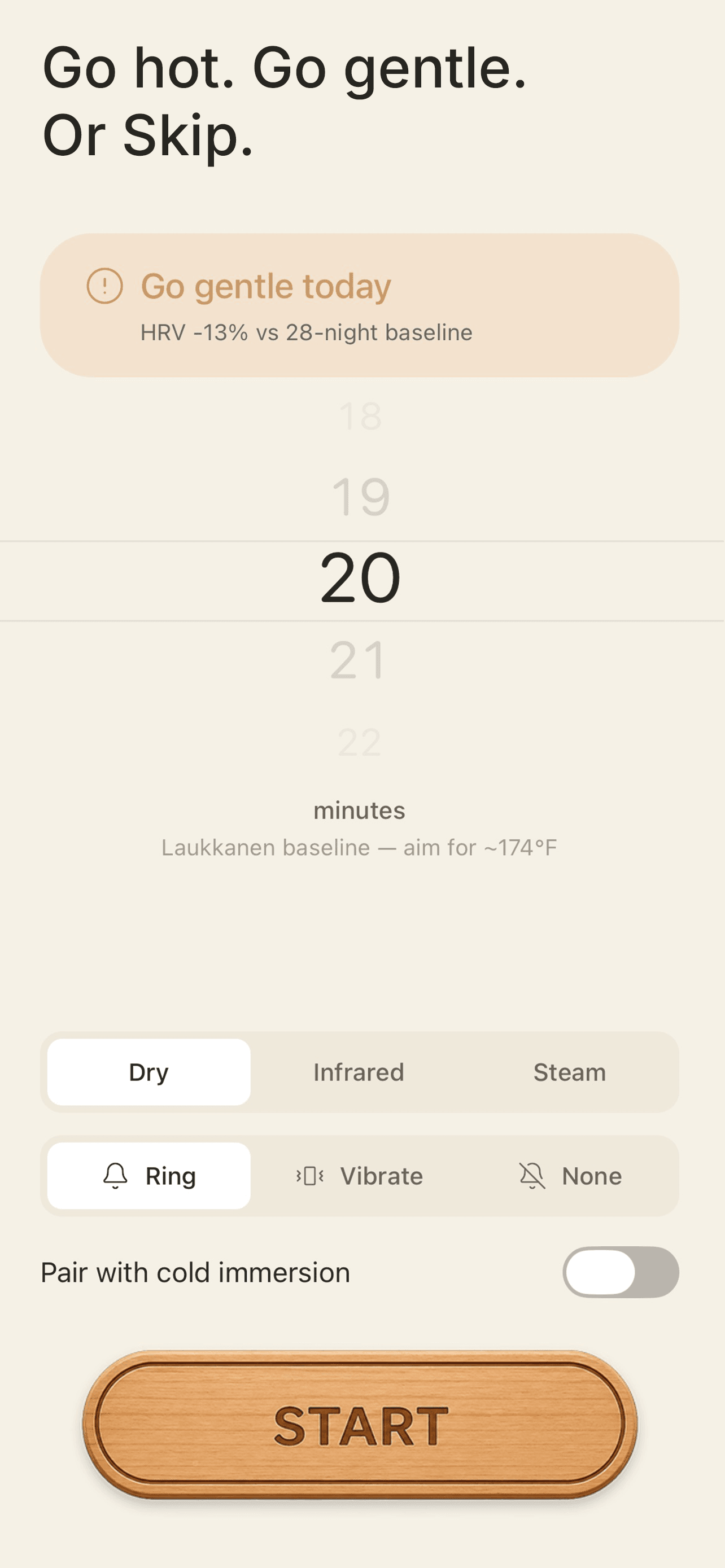
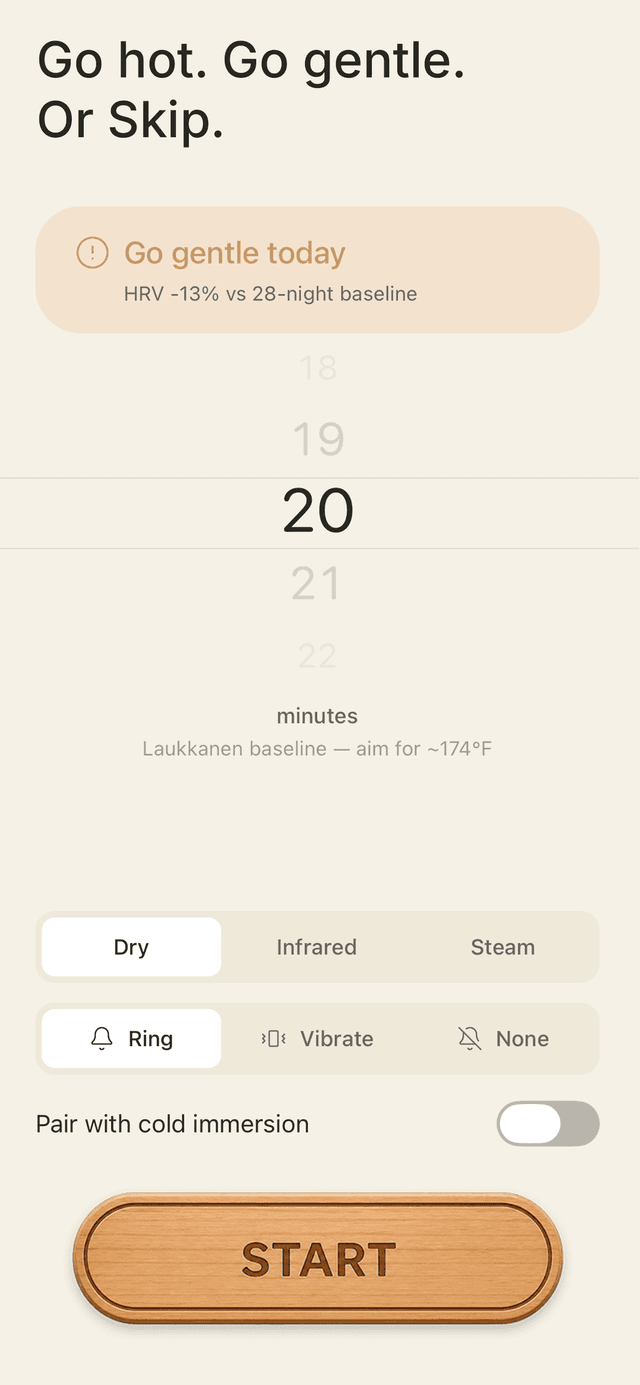
Go hot, go gentle, or skip.
Each morning you get one of three readings, based on your HRV against your baseline, last night's sleep, your resting heart rate, and how much heat you've already taken on over the past seven days.
There's no ring to close and no streak to protect. It's just a daily read with three options, drawn from your own numbers, meant to inform the call rather than make it for you.
Sleep score
A sleep score grounded in sleep medicine.
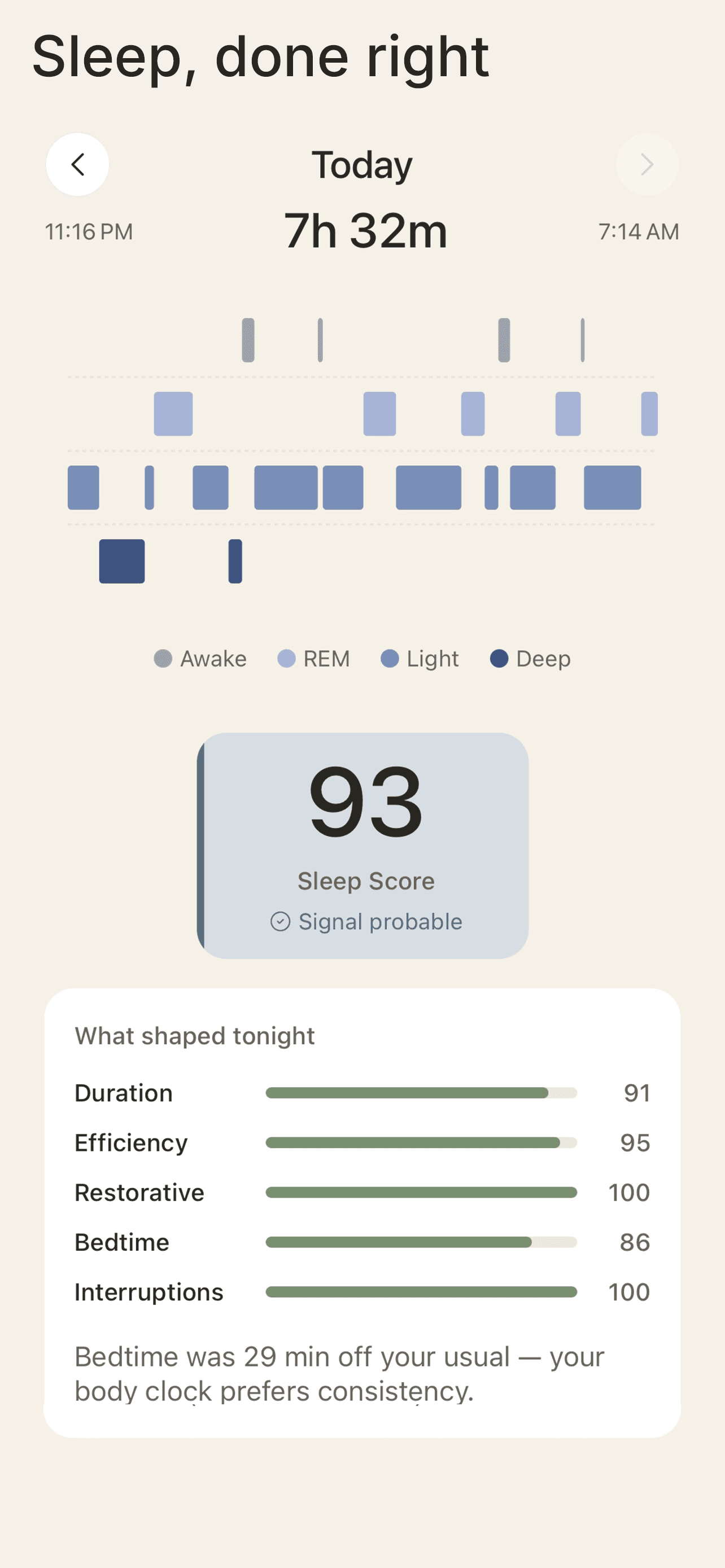
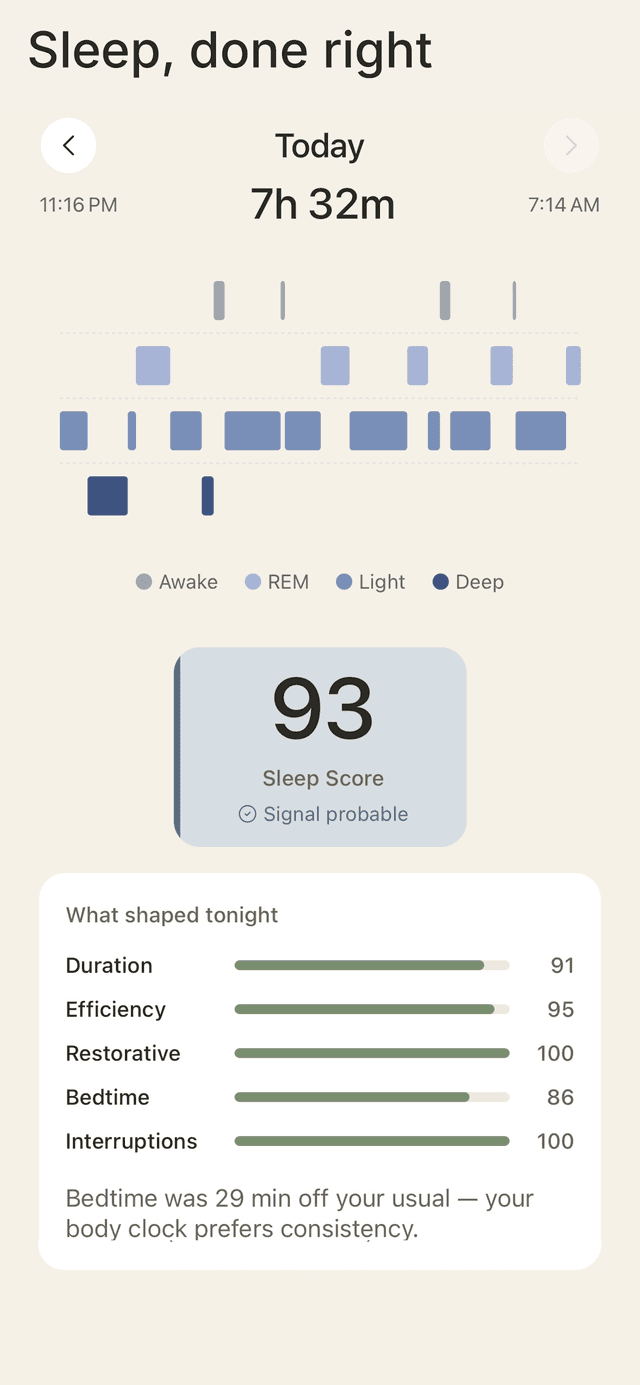
Every night, Sauna Score builds a 0–100 read from five things: Performance (duration), Efficiency (awake time), Restorative (Deep + REM), Bedtime (drift from your 7-night onset median), and Interruptions (awakening count). The targets aren't chosen to make you feel good; they come from the AASM consensus, which puts combined Deep + REM around 35% and 3–5 awakenings in the normal adult range.
What shaped tonight
The detail screen surfaces your weakest sub-score rather than your best, which is deliberate: a low night shows you what to work on, and a high night confirms the basics are still holding. One useful sentence is more honest than five status lines.
Your watch can't go in
Your wearable can't follow you into the heat.
The temperatures explain why. Oura's operating range tops out at 52°C, the Apple Watch is rated to 35°C, and even Garmin's outdoor watches struggle in the heat, while a sauna runs 80–95°C (here's what the heat actually does to phones, watches, and rings). And even a device that survives can't read your HR or HRV accurately in there, because everyone's heart rate climbs at 100°C, so a high reading mostly just tells you the room is hot.
Which is fine, because the in-session number was never the useful one. Sauna Score reads your morning baseline before the sauna and your overnight recovery after, and that's where the trend worth watching actually shows up.
The alarm reaches you
Watch can't go in. The alarm still rings.
Sauna Score schedules a high-priority iOS alarm that still goes off with the phone locked in a locker or resting just outside your own sauna door, and it carries through Focus modes. Ring or vibrate, whichever you prefer.
If you want to know whether it's working,
install Sauna Score.
It's built around the one question your wearable leaves unanswered: is any of this actually working?
Download for iOS / AndroidSourcesshow
- Laukkanen JK, Laukkanen T, Kunutsor SK. Association between sauna bathing and fatal cardiovascular and all-cause mortality events. JAMA Internal Medicine, 2015.
- Søberg S, Löfgren J, Philipsen FE, et al. Altered brown fat thermoregulation and enhanced cold-induced thermogenesis in young, healthy, winter-swimming men. Cell Reports Medicine, 2021.
- Watson NF, Badr MS, Belenky G, et al. Recommended amount of sleep for a healthy adult: a joint consensus statement of the AASM and SRS. Sleep, 2015.
- Pilch W, Pokora I, Szyguła Z, et al. Effect of a single Finnish sauna session on white blood cell profile and cortisol levels in athletes and non-athletes. Journal of Human Kinetics, 2013.